
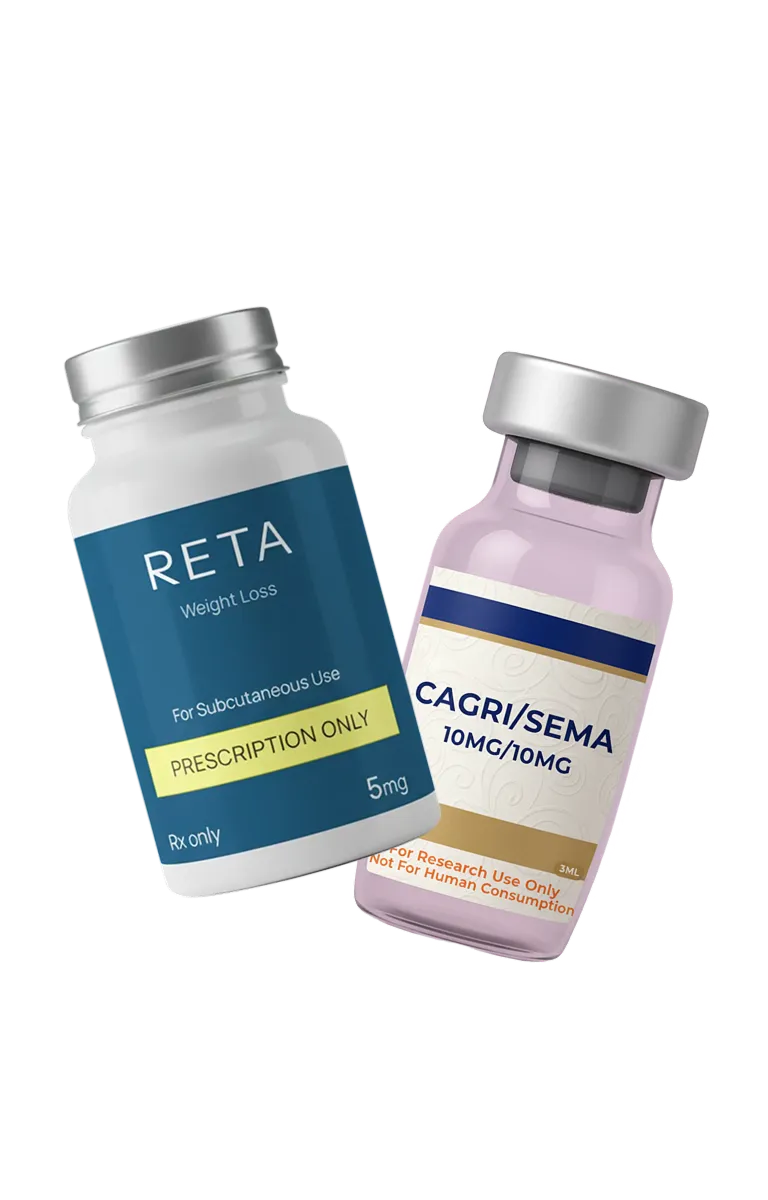
CagriSema vs Retatrutide is the debate currently dominating the world of metabolic science in 2026. At ProPharma Peptides, we receive daily inquiries from researchers asking which of these “Next-Gen” agonists is superior for weight reduction and metabolic optimization. The truth is that while both are incredibly potent, they operate through distinct biological pathways.
In this 1,500-word guide, we will break down the mechanisms of action, the research results, and the synergy of these two powerhouses so you can determine the best protocol for your research facility.
Table of Contents
I.The Evolution of Peptide Agonists in 2026
II.Understanding CagriSema: The Dual-Action Powerhouse
III.Understanding Retatrutide: The Triple-Agonist Revolution
IV.CagriSema vs Retatrutide: The Key Differences
V.Choosing the Right Protocol for Your Research
VI.The Importance of Quality and Purity in Agonists
VII.Conclusion: The Future of Weight Loss Research
I. The Evolution of Peptide Agonists in 2026
We have come a long way from the early days of simple GLP-1 agonists. In 2026, the focus has shifted toward multi-agonism—stimulating several hormone receptors at once to create a more comprehensive metabolic shift. This approach prevents the “weight loss plateaus” common in older protocols.
When comparing CagriSema vs Retatrutide, we are looking at the peak of this evolution: one focuses on the synergy of insulin and satiety, while the other targets the “Triple-G” metabolic engine.
II. Understanding CagriSema: The Dual-Action Powerhouse
CagriSema is a fixed-dose combination of Cagrilintide (a long-acting amylin analog) and Semaglutide (the well-known GLP-1 analog).
How it Works:
• GLP-1 (Semaglutide): Slows gastric emptying and signals the brain to reduce appetite.
• Amylin (Cagrilintide): A hormone co-secreted with insulin that further increases satiety and helps regulate glucose levels.
• The Result: By targeting hunger through two different pathways, CagriSema often yields weight loss results far superior to Semaglutide alone.
III. Understanding Retatrutide: The Triple-Agonist Revolution
Retatrutide, often called “The Triple-G,” is a single peptide that targets three receptors: GLP-1, GIP (Gastric Inhibitory Polypeptide), and Glucagon.
The Glucagon Difference:
The inclusion of a glucagon receptor agonist is what sets Retatrutide apart. While GLP-1 and GIP focus on appetite and insulin, Glucagon increases energy expenditure (thermogenesis) and targets fat in the liver. This makes Retatrutide the most potent “metabolic burner” in the ProPharma Peptides inventory.
IV. CagriSema vs Retatrutide: The Key Differences
CagriSema (The Satiety Specialist)
• Agonist Type: Dual (GLP-1 + Amylin).
• Appetite Suppression: Extreme. By doubling up on satiety signals, it is the 2026 gold standard for eliminating “food noise.”
• Metabolic Boost: Moderate. Focuses more on calorie restriction than calorie burning.
• Best For: Researchers targeting high-hunger subjects or those prone to overeating.
Retatrutide (The Metabolic Burner)
• Agonist Type: Triple (GLP-1 + GIP + Glucagon).
• Appetite Suppression: High. Significant, but generally considered slightly less intense than CagriSema.
• Metabolic Boost: Extreme. The Glucagon receptor actively increases the body’s basal metabolic rate.
• Liver Health: Very High. Proven to target ectopic fat and liver adiposity specifically.
• Best For: Overcoming plateaus and maximizing fat oxidation through thermogenesis.
V. Choosing the Right Protocol for Your Research
When deciding between CagriSema vs Retatrutide, consider the primary goal of the study:
• Choose CagriSema if the subject struggles with intense hunger. The dual-satiety effect is unmatched for strict calorie control.
• Choose Retatrutide if the goal is maximum fat oxidation, liver restoration, or overcoming a plateau where previous dual-agonists have failed.
VI. The Importance of Quality and Purity in Agonists
Because these peptides are so potent, purity is paramount. A 1% impurity in a triple-agonist can lead to significant immune responses. At ProPharma Peptides, our agonists are subjected to Triple-Stage HPLC Testing to ensure that every vial provides the exact milligram weight and sequence required for valid research.
VII. Conclusion: The Future of Weight Loss Research
Whether you choose CagriSema or Retatrutide, you are at the forefront of 2026 metabolic science. Both compounds represent a move away from “brute force” weight loss and toward elegant, hormonal orchestration.