
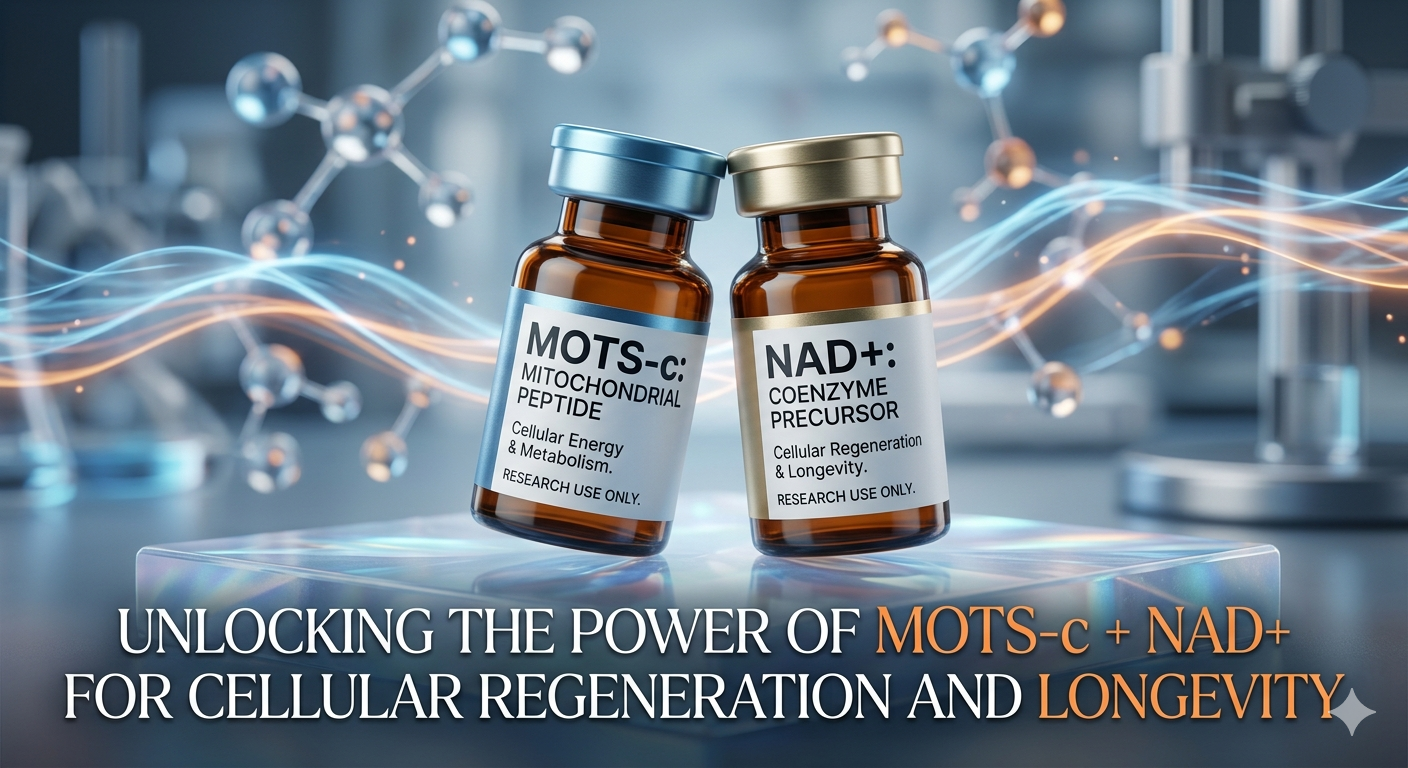
MOTS-c and NAD+ benefits represent the cutting edge of 2026 metabolic research, offering a dual-layered approach to cellular energy that traditional supplements simply cannot match. At ProPharma Peptides, we have analyzed the shifting landscape of biohacking and found that the most successful research protocols are no longer focusing on single-target solutions. Instead, they are prioritizing mitochondrial synergy.
In this 1,500-word dossier, we will break down the exact biological mechanisms that make this stack the “Gold Standard” for metabolic flexibility, energy production, and age-deceleration.
Table of Contents
1. The Role of Mitochondria in 2026 Performance
2. MOTS-c: The Exercise-Mimetic Revolution
3. NAD+: The Spark Plug of the Cell
4. Why Stack MOTS-c and NAD+? (The Synergy)
5. Protocol and Reconstitution for Researchers
6. The 2026 “Metabolic Flexibility” Biomarkers
7. Why Quality Control is Non-Negotiable
I. The Role of Mitochondria in 2026 Performance
The mitochondria are often called the “power plants” of the cell, but in 2026, we view them as the metabolic governors. They determine how efficiently your body uses fuel (glucose and fat) and how quickly it repairs damage. When your mitochondria are sluggish, your entire research protocol—whether for fat loss or muscle gain—will underperform.
By focusing on MOTS-c and NAD+ benefits, researchers can effectively “re-tune” these governors, allowing the body to switch between fuel sources with ease. This is known as Metabolic Flexibility.
II. MOTS-c: The Exercise-Mimetic Revolution
MOTS-c (Mitochondrial Open Reading Frame of the 12S rRNA-c) is a 16-amino acid peptide that acts as a signal to the body that it is undergoing physical stress. It is often referred to as an “exercise mimetic” because it triggers many of the same biological pathways as a high-intensity mountain bike ride or a weightlifting session.
How MOTS-c Signals the Cell:
• AMPK Activation: MOTS-c turns on the AMPK pathway, the body’s master metabolic switch.
• Glucose Regulation: It increases the expression of GLUT4, allowing muscles to pull sugar from the blood more efficiently.
• Fat Oxidation: It signals the mitochondria to prioritize fat-burning, making it a perfect partner for weight loss peptides like Retatrutide or CagriSema.
III. NAD+: The Spark Plug of the Cell
While MOTS-c provides the command to work, NAD+ provides the energy to carry it out. NAD+ (Nicotinamide Adenine Dinucleotide) is a coenzyme found in all living cells and is required for the electron transport chain to produce ATP.
The Problem of Depletion:
Natural NAD+ levels decline by roughly 1% per year after age 25. By age 52, your levels are likely a fraction of what they were in your youth. This “NAD+ Gap” is why many researchers feel a decline in stamina and an increase in “brain fog.”
MOTS-c and NAD+ benefits work together here: NAD+ recharges the cellular battery, while MOTS-c ensures that the battery is powering the right metabolic tasks.
IV. Why Stack MOTS-c and NAD+? (The Synergy)
The magic of this stack happens through a biological “Push-Pull” relationship.
1. The MOTS-c Push: MOTS-c pushes the mitochondria to increase output and metabolic efficiency.
2. The NAD+ Pull: NAD+ provides the necessary “pull” to carry those electrons through the system without creating excessive oxidative waste.
Synergy Checklist:
• Enhanced Stamina: Research subjects report a “clean” energy increase that lasts all day.
• Improved Recovery: By reducing oxidative stress, the body repairs micro-tears in muscle and connective tissue faster.
• Metabolic Priming: This stack prepares the body for more aggressive fat-loss protocols, ensuring the metabolism doesn’t “crash” during a deficit.
V. Protocol and Reconstitution for Researchers
Precision in the lab is required to maximize MOTS-c and NAD+ benefits.
Reconstitution Basics:
Both MOTS-c and NAD+ should be reconstituted using Bacteriostatic Water. As discussed in our [Peptide Math Masterclass], the “Gentle Drip” method is essential to preserve the delicate amino acid chains.
The 2026 Mitochondrial Protocol:
• MOTS-c: 5mg to 10mg, administered 1–2 times per week. Many researchers find that a “loading phase” of 10mg once a week for 4 weeks yields the best results.
• NAD+: 50mg to 100mg, administered 3 times per week. For those using ProPharma Peptides high-purity NAD+, morning administration is recommended to align with natural circadian rhythms.
VI. The 2026 “Metabolic Flexibility” Biomarkers
To prove the efficacy of your research into MOTS-c and NAD+ benefits, you should monitor the following 2026 health markers:
• HOMA-IR: A measure of insulin resistance and sensitivity.
• Lactate Threshold: High mitochondrial efficiency leads to better lactate clearance.
• Heart Rate Variability (HRV): A higher HRV often indicates a more resilient, well-recovered nervous system.
VII. Why Quality Control is Non-Negotiable
At ProPharma Peptides, we understand that MOTS-c is one of the most fragile peptides in existence. If it is exposed to high temperatures or light during shipping, it can degrade into “inactive” fragments.
We utilize Cold-Chain Synthesis and Vacuum-Sealed Lyophilization to ensure that your research materials arrive with 99%+ purity. When you are looking for the best MOTS-c and NAD+ benefits, the source is the most important variable.