
In the rapidly evolving world of 2026 peptide research, precision is the difference between a successful study and a failed experiment. While the benefits of compounds like Retatrutide or BPC-157 are well-documented, the most common hurdle for researchers isn’t the science of the peptide itself—it is the mathematics of the vial.
Understanding the relationship between milligrams (mg), micrograms (mcg), milliliters (mL), and insulin units is non-negotiable. At ProPharma Peptides, we believe that transparency in education is just as important as the purity of our products.
This guide serves as the definitive 2026 resource for accurately reconstituting your research materials and mastering the unit-to-dose conversion.
I. The Fundamentals: Understanding the Metrics
Before we pick up a syringe, we must define our terms. Confusion often arises because researchers use different metric systems for mass versus volume.
1. Milligrams (mg) and Micrograms (mcg)
These measure mass (the weight of the actual peptide powder in the vial).
• 1 Milligram (mg) = 1,000 Micrograms (mcg).
• Example: If you have a 5mg vial of Tirzepatide, you actually have 5,000mcg of research material.
2. Milliliters (mL) and Units
These measure volume (the liquid you add to the powder).
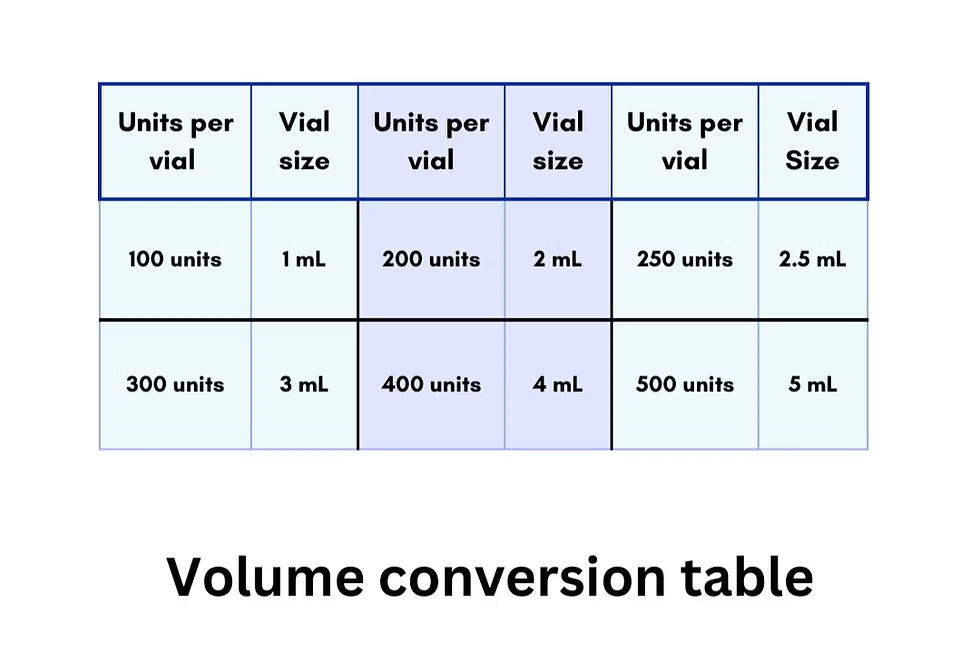
• 1 Milliliter (mL) = 100 Units on a standard U-100 insulin syringe.
• 0.5 mL = 50 Units.
• Example: If you add 1mL of Bacteriostatic Water to a vial, you have “filled the tank” with 100 units of liquid.
II. The Reconstitution Process: A Step-by-Step Protocol
Reconstitution is the process of adding a solvent (typically Bacteriostatic Water) to a lyophilized (freeze-dried) peptide powder to turn it into an injectable solution.
The Equipment:
1. Lyophilized Peptide: (e.g., a 10mg vial of Tesamorelin from ProPharma Peptides).
2. Bacteriostatic Water (BAC): Sterile water containing 0.9% benzyl alcohol to prevent bacterial growth.
3. Alcohol Swabs: For sanitizing vial stoppers.
4. Reconstitution Syringe: Usually a larger 3mL syringe for transferring water.
5. Insulin Syringe: Usually 0.5mL or 1mL (U-100) for the final research administration.
The 2026 “Pro-Purity” Technique:
• Sanitize: Wipe the top of both the BAC water and the peptide vial with an alcohol swab.
• Equalize Pressure: Draw 1mL of air into your large syringe and inject it into the BAC water vial before drawing out the liquid. This prevents a vacuum from forming.
• The Gentle Drip: When injecting the water into the peptide vial, never spray the water directly onto the powder. This can “bruise” or shear the delicate peptide chains. Instead, aim the needle at the side of the glass wall and let the water slowly trickle down.
• No Shaking: Swirl the vial gently until the solution is clear. Shaking can denature the peptide, rendering it useless.
III. Mastering the Peptide Math (The Formula)
This is where most researchers get stuck. The goal is to determine how many units on your syringe equal your desired mcg dose.
The Universal Formula:
(Total mg of Peptide / Total mL of Water) x 1,000 = mcg per mL
Example Research Scenario:
You have a 5mg vial and you add 2mL of BAC water.
1. (5mg / 2mL) = 2.5mg per mL.
2. 2.5mg x 1,000 = 2,500mcg per mL.
3. Since 1mL = 100 units, you divide 2,500 by 100.
4. Result: Each 1 unit on your syringe equals 25mcg.
Common 2026 Dosing Conversions:
• If your goal is a 250mcg dose of BPC-157: You would draw to the 10-unit mark on the syringe in the scenario above.
IV. Why Does the Volume of Water Matter?
A common question we receive at ProPharma Peptides is: “Does adding more water make the peptide weaker?”
The answer is No. The total amount of peptide (the mass) remains the same regardless of how much water you add. However, the concentration changes.
• Less Water: Means a more concentrated solution. You inject a smaller volume of liquid to get your dose.
• More Water: Means a more diluted solution. This is often preferred for peptides that might cause localized stinging (like GHK-Cu), as the dilution makes the administration more comfortable.
V. Unit Conversions: A Copy-Paste Reference Guide
For researchers who want a quick “Cheat Sheet,” here is a standard breakdown using 1mL (100 units) of water.
Vial Size: 2mg
• 5 units = 100mcg
• 10 units = 200mcg
• 25 units = 500mcg
Vial Size: 5mg
• 2 units = 100mcg
• 10 units = 500mcg
• 20 units = 1mg (1,000mcg)
Vial Size: 10mg
• 1 unit = 100mcg
• 5 units = 500mcg
• 10 units = 1mg (1,000mcg)
VI. Storage and Stability in 2026
Once a peptide is reconstituted, the “biological clock” starts ticking.
• Refrigeration: Reconstituted peptides must be kept in a refrigerator between 2°C and 8°C (36°F – 46°F).
• Light Sensitivity: Keep vials in the dark. Exposure to UV light can degrade the amino acid bonds.
• Shelf Life: Most reconstituted peptides are stable for 28 to 30 days. After this, the potency may begin to decline.
VII. Why Quality Synthesis Matters for Math
Precision math only works if the vial contains exactly what the label says. In 2026, many low-tier suppliers have “fill drift,” where a 5mg vial might only contain 4.2mg. This makes your math inaccurate and your research invalid.
At ProPharma Peptides, we utilize precision-filling technology that ensures a +/- 1% variance, meaning your calculations will always match the biological reality of your study.